THE FUTURE OF MUSEUMS: WHERE RELEVANCE MEETS INNOVATION
ABOUT FUTURE MUSEUMS
Museums have long served as gateways to the past, preserving our collective memory through artifacts, artworks, and historical narratives. But in today’s rapidly evolving world, museums hold an even greater power, not just to reflect history, but to actively shape the future. As the needs and expectations of audiences change, so too must the institutions that serve them. This is where Future Museums comes in.
At Future Museums, we believe that museums must be dynamic, relevant, and deeply connected to the communities they serve. The world is moving fast, and audiences are demanding more, more interactivity, more contemporary relevance, and more meaningful engagement. We work with museums to reimagine exhibitions, permanent galleries, audience engagement strategies, and programming to ensure they remain vital and future-focused. Our mission is to take museums out of the 20th-century model and position them as centres of innovation, storytelling, and community-driven knowledge sharing.
MUSEUMS AS HUBS OF CONTEMPORARY THOUGHT AND INNOVATION
Museums must do more than house collections; they must act as platforms for new ideas, dialogue, and discovery. With a future-focused approach, museums can present current issues, from climate change to social justice, from artificial intelligence to human rights, while maintaining the integrity of their collections and curatorial expertise.
In the book Cultivating Futures Thinking in Museums, edited by Kristin Alford, the call to action is clear: museums must embrace futures thinking to remain relevant in a world of rapid change. Alford argues, “Museums need to move beyond simply reflecting on the past and begin actively engaging in conversations about the future.”
Future Museums takes this principle and applies it with practical, tangible solutions that ensure museums stay ahead of shifting audience expectations.We help institutions ask the critical questions: What are the urgent issues of our time? How can museums respond to and shape the cultural landscape? What does an audience-first approach look like in a digital age? Our work is rooted in storytelling, rigorous knowledge, immersive technology, audience research, and innovative design—ensuring that museums not only preserve history but also inspire the future.
HOW WE WORK WITH MUSEUMS
Our approach is hands-on, actionable, and focused on real-world impact. We collaborate with institutions to provide:
1. VISION & STRATEGIC PLANNING
We develop bold, future-focused roadmaps for museums that align with audience needs, financial sustainability, and environmental responsibility. Our strategic planning ensures that museums and collections remain relevant while staying true to their mission and collections.
2. AUDIENCE ENGAGEMENT STRATEGIES
Today’s visitors seek interactive, meaningful experiences. We design and implement programs that increase attendance, attract new demographics, and create deeper audience engagement through participatory storytelling, digital tools, and dynamic programming.
3. GALLERY DESIGN
We create immersive, multi-sensory experiences that go beyond static displays. By integrating cutting-edge technology like AI, AR, and interactive installations, we bring collections to life in ways that are engaging, educational, and accessible.
4. CURATORIAL RELEVANCE
Museums are to address urgent societal topics while staying authentic to their collections. We design exhibitions and programs that explore contemporary themes, such as climate change, social equity, and the future of humanity, using museum collections as the foundation for new, thought-provoking narratives.
5. TRAVELING EXHIBITIONS & COMMERCIAL
We create traveling exhibitions that expand a museum’s reach and generate revenue. By leveraging collections in innovative ways, museums can develop financially sustainable models that maximise impact without sacrificing intellectual rigour.
6. SUSTAINABILITY & OPERATIONAL EFFICIENCY
Museums must lead by example in environmental responsibility. We advise on eco-conscious design, energy efficiency, and sustainable exhibition practices, ensuring that institutions reduce their footprint while enhancing visitor experiences.
STEVEN ALDERTON
Steven Alderton is the director of Future Museums and is a museum planner, collection strategist and curator with 30 years at the head of art institutions. He advises collectors, foundations and their architects on the creation of new museums, from concept and mission through masterplanning, collection policy, governance and operating models to the curatorial program that opens the building. He is an art and audience specialist working across the Asia-Pacific and has been engaged as expert adviser to build key international art collections and innovative art museums.
As Director and CEO of the National Art School in Sydney he led the masterplan for the institution, setting its mission, its scope and the long-term use of every space on the site. He works to a full masterplanning method: mission, vision and collecting scope defined first, then the functional brief and space schedule, area allocation, adjacency and circulation, visitor flow, environmental and security zoning, collection growth projected over 25 years, phasing of capital works, capital and operating cost modelling, governance and staffing structure, and the strategic business case that carries the project to funding approval. He writes Investment Logic Maps and Treasury standard strategic business cases for public and private cultural capital projects.
As Deputy Director of the Australian Museum, custodian of more than 21 million objects and specimens, he was responsible for the Pacific collection, approximately 67,000 cultural objects representing more than 22 nations. The role covered collection strategy and policy, registration and cataloguing, conservation, offsite storage and researcher access, and the protocols governing culturally sensitive material, restricted and sacred objects, ancestral remains and repatriation, conducted with source communities across the Pacific. He also held responsibility for audience development and the museum's public engagement spaces, from permanent and temporary galleries to education, visitor experience and touring. He delivered the landmark exhibitions Garrigarrang: Sea Country and Pacific Spirit and directed international touring exhibitions to more than 20 venues, including the Royal Ontario Museum. He has also served as Director of Mosman Art Gallery, Lismore Regional Gallery and Casula Powerhouse Arts Centre.
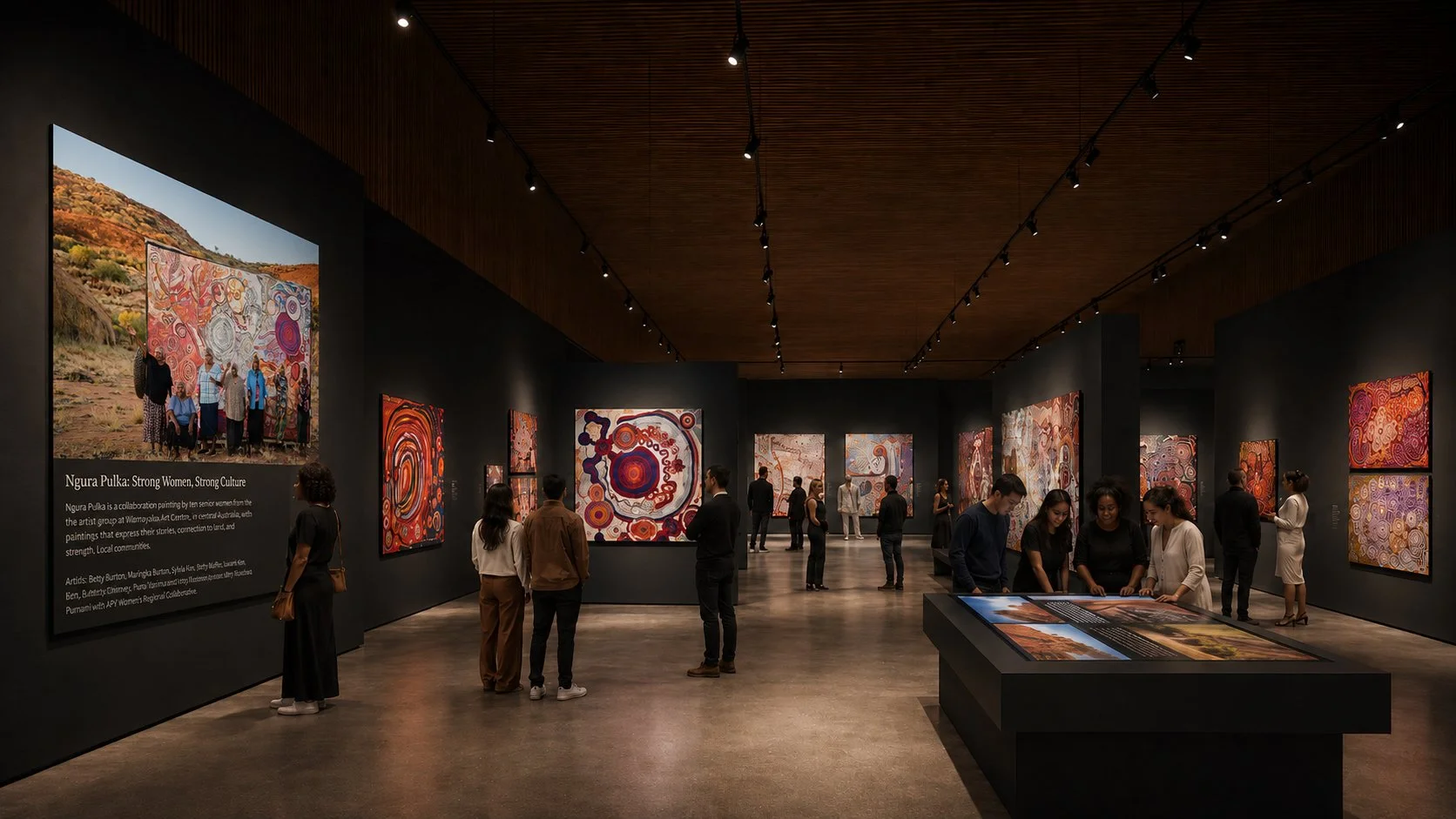
He has written the Collection Policies for four Australian institutions, governing acquisition, provenance and title, documentation, valuation, insurance, deaccession and public access, and has developed more than 300 exhibitions across Australian, Asia-Pacific and First Nations art. He is currently touring Ngura Pulka, the major exhibition of APY Lands art shown at the National Gallery of Australia, and is curating a group exhibition at the Liu Haisu Art Museum in Shanghai.
Steven chaired the $70m Creative Capital arts funding board for the NSW Government and served on the Visual Arts Board of the Australia Council and the 24-Hour Economy Advisory Group for Investment NSW. He is Head of Art and Philanthropy at Hurun Australasia and Chair of the Sydney Marae Alliance Foundation. Through the Asia-Europe Museum Network and the Asia Pacific Network of Science and Technology Centres he worked on cultural exchange and museum practice across Europe and the Asia-Pacific, and he served on the Corroboree Festival Working Group supporting First Nations storytelling, collections and public art.
Join us in transforming art museums from institutions of preservation to centers of innovation. Let’s reimagine what’s possible, together.